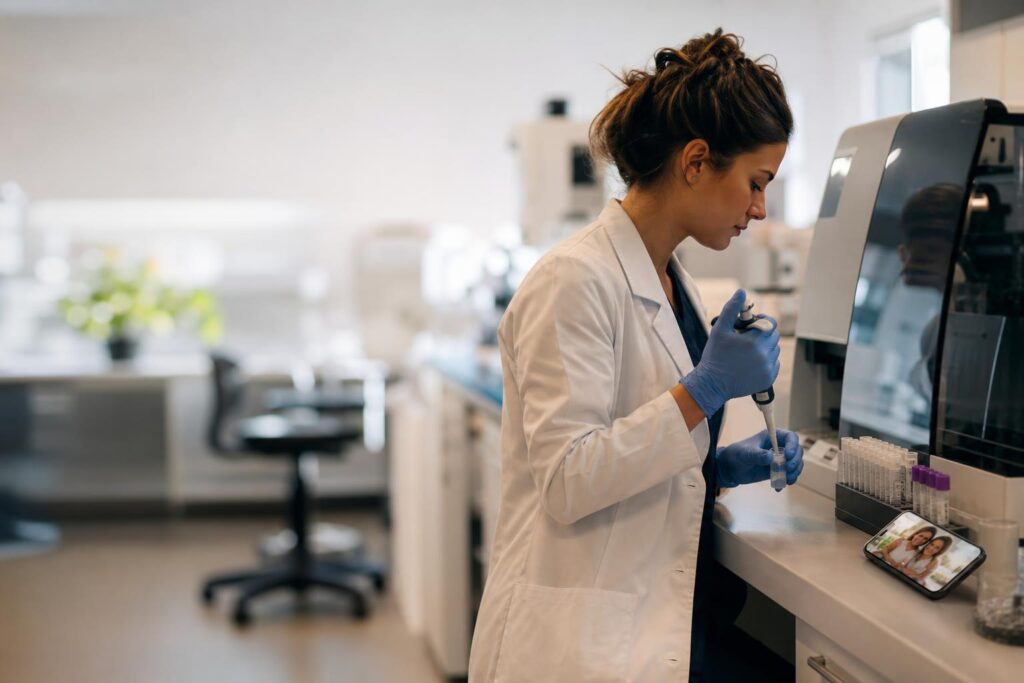
The family text usually arrives at the exact moment your hands are full. One glove is on, the analyzer wants attention, specimens are waiting, pending work is stacking up, and your phone vibrates like it has no respect for STAT testing.
On the screen, it can look like silence. In the lab, it can mean you saw the message, cared about it, and still had to finish what was right in front of you. Here is the tension: family wants to feel remembered, and we also work in a place where attention has to be clean, steady, and sometimes immediate.
Medical technologists and lab professionals know this tiny guilt very well. A message comes in from home. Maybe it is simple. Maybe it is a question that needs an answer. Maybe it is just someone checking in. You want to reply like a normal human being. Then the analyzer alarms, the phone rings, another specimen arrives, and your brain goes back to work mode.
It is a strange kind of love, answering later.
The phone does not know you are in the middle of work
Family messages do not come with a lab schedule attached. They come when they come. During lunch, before lunch, after lunch, or during the kind of shift where lunch becomes a theory.
The phone only shows the message. It does not show the analyzer. It does not show the specimens that need to be handled properly. It does not show the pending work sitting there like a quiet reminder that the shift is not slowing down just because someone asked, “Kumain ka na?”
That is one of the hard parts. Our families see the delay. They do not always see the competition for our attention. Analyzer. Phone. Specimens. Pending work. Sometimes all at once.
And honestly, even we can forget that this is not normal life for everybody. In the lab, we get used to pausing personal things because the work in front of us has to be done right. A result needs checking. A specimen needs processing. A machine needs troubleshooting. The rhythm of the shift teaches you to postpone almost everything that is not part of the current task.
That does not mean family becomes unimportant. It means the lab has moments where a half-distracted reply is not the best reply.
A short reply is better than disappearing
One small line can help a lot: “I’ll reply later.”
It looks too short. It feels unfinished. Sometimes it even feels cold if you read it without context. But during a busy shift, that small message can carry a lot. It says, “I saw this.” It says, “I’m not ignoring you.” It says, “I can’t give you a proper answer right now, but I will come back to it.”
That is still love.
Not every message needs a full paragraph right away. Sometimes trying to write a proper response while your attention is split only creates more stress. You type two words, delete them, look back at the analyzer, forget what you were saying, then accidentally leave the message open and unread-looking for three hours. Very peaceful. Very healthy. Very lab life.
A short reply gives both sides a little mercy. Your family gets a signal that you are still present. You get permission to return to work without carrying the full weight of the message in your head.
There is also something honest about it. We do not need to pretend we are always available. Hospital work does not always allow that. The better habit is to communicate clearly when availability is limited.
“I’ll reply later” is not a perfect sentence, but it is useful. And in the middle of a busy shift, useful is already a blessing.
The guilt is real, even when nobody is upset
Sometimes the family member is not even angry. They just sent a text. You are the one feeling bad because you know you have not answered yet.
That guilt can sit in the back of your mind while you are working. You check the phone quickly, see the message, and think, “I’ll answer after this.” Then “this” becomes another thing. Then another specimen. Then the pending work is still there. By the time you remember, the message feels older than it actually is.
This is where lab people can be too hard on themselves. We are trained to respond to problems quickly. We see alarms, flags, critical values, pending lists, and incomplete tasks. So when a family message stays unanswered, it can feel like another pending item. Except this one has feelings attached.
But family life is not an analyzer queue. It does not have to be cleared in strict order with no emotional carryover. A delayed answer can be repaired with a simple explanation: “Sorry, busy shift. I saw your message but couldn’t reply properly.”
That sentence is not dramatic. It does not need a long defense. Most of the time, family just needs to know you did not vanish into the hospital basement forever.
And if you work in a lab that really is in the basement, then yes, the joke writes itself.
Family learns your schedule, but they need clues
One thing that helps over time is that family starts to learn your work rhythm. They begin to understand that there are hours when replies may be slow. They learn that a busy shift does not always leave space for long conversations. They notice patterns.
But they learn faster when we give them clues.
If your family knows that messages may sit during work hours, the delay feels less personal. If they know that you will answer during break or after shift, they do not have to guess. The silence becomes easier to interpret.
This does not require a complicated system. It can be as simple as saying before work, “I’m on shift today, replies might be late.” Or after a hectic day, “Sorry, the lab was busy. I’m home now.” Small updates can prevent a lot of misunderstanding.
Families are not mind readers. Neither are we. A little communication before the busy part can save both sides from filling in the blanks.
There is also a difference between being unreachable and being unavailable for a while. We can help family understand that. A lab shift may limit your response time, but it does not erase your care for them.
We also learn how to communicate better
The learning goes both ways. Family learns our schedule, and we learn how to be clearer.
That part is not always comfortable. Many of us are good at lab communication because the work forces us to be specific. We can document, verify, call, repeat back, and check details. Then with family, we sometimes become vague. “Later.” “Busy.” “Wait.”
Those words are not wrong, but they can sound sharper than we mean them, especially through text. A tiny adjustment helps.
- “I’ll reply later, busy at work.”
- “Saw this. I’ll answer after shift.”
- “Can’t talk now, but I’m okay.”
- “Give me time. Analyzer and specimens are fighting me today.”
That last one may only work if your family already understands your humor. Use with caution.
The point is not to create perfect messages. The point is to reduce guessing. In the lab, unclear information creates problems. At home, unclear silence can do the same thing.
A short, kind text can protect both sides. It protects your focus at work, and it protects the relationship from unnecessary worry.
Busy does not mean disconnected
This is the line I come back to: busy does not mean disconnected.
It can feel that way, especially when the shift eats your time and your phone is full of messages you meant to answer. But connection is not measured only by instant replies. It also shows in the fact that you come back to the message later. It shows in the quick “I saw this.” It shows in explaining your day without making your family feel like they are an interruption.
There are days when the best you can offer during work is a short response. That is still something. Then later, when the analyzer is no longer calling your name and the specimens are no longer lined up, you can give the fuller version.
Lab work teaches us to prioritize. It also teaches us that timing matters. Some things need immediate action. Some things need careful follow-up. Family communication can be like that too. If it is urgent, of course, that changes everything. But many everyday messages can wait a little, as long as the person on the other side is not left wondering if you forgot them.
There is no perfect balance here. Some shifts are simply packed. Some families are more anxious. Some days you are tired and your reply sounds flatter than you intended. That is real life. The goal is not to be available every second. The goal is to keep the line warm, even when work is heavy.
So if you are reading this during break with three messages waiting, start small. Send the short reply. Tell them you saw it. Tell them you will answer later. Then go back to the analyzer, the phone, the specimens, and the pending work with a little less guilt.
And when the shift finally gives you room, go back to the message. A delayed reply can still be a loving one, especially when the people at home know you are coming back to them.