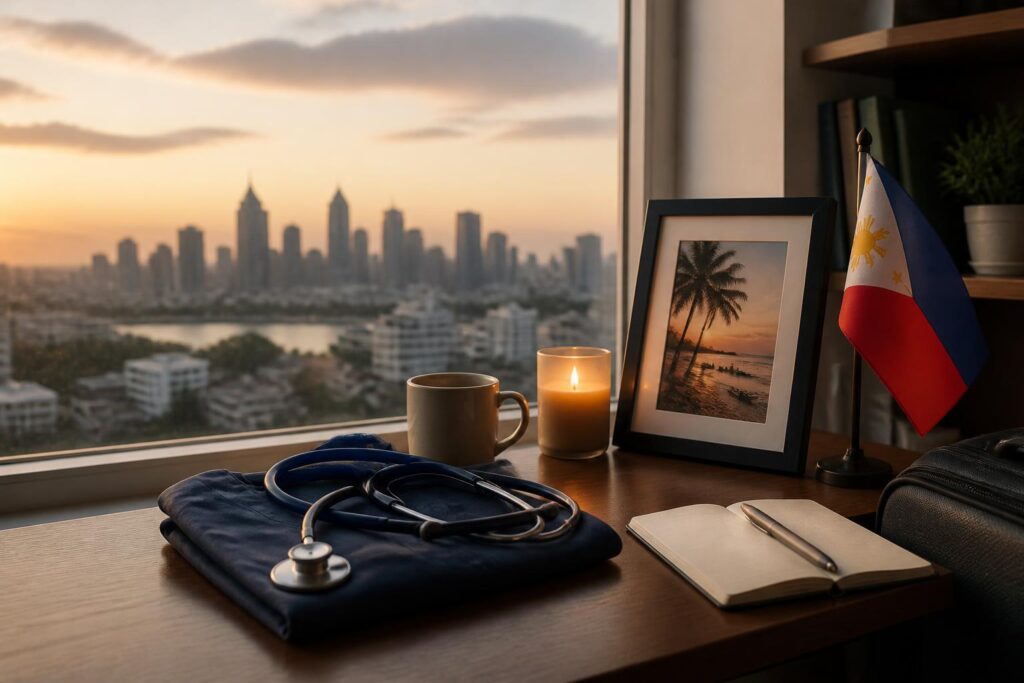
The hard part is when life in America is genuinely good, but your heart still pulls toward home. You can be thankful for a steady job, a safer routine, and the chance to grow as a Filipino MedTech in the USA, and still feel the ache of missed birthdays, aging parents, and familiar places that used to be part of ordinary life.
That is the tension I think many medical technologists and lab professionals abroad quietly carry. From the outside, migration can look like one clean success story. You passed the exams, got the job, wore the badge, learned the analyzer, adjusted to the hospital system, and started building a life. Those are real blessings. They should not be minimized.
But there is another side that does not always fit neatly into a congratulatory message. Home keeps moving while you are away.
Missing home does not mean you made the wrong choice
I think this is important to say plainly, especially for those of us who left the Philippines to work in a hospital laboratory abroad: homesickness is not proof that the move was a mistake.
There are days when gratitude is easy. A good shift ends, the instruments behaved, the QC passed, the workload was manageable, and the paycheck helps with real responsibilities. There is comfort in knowing that the sacrifice has a purpose. Life in America can open doors that were difficult to reach before.
Then there are days when the cost feels heavier. A birthday happens back home and you are on duty. Your parents are getting older, and you notice it through photos, video calls, or small changes in their voice. A familiar street, food, church, weather, or language suddenly feels far away. Nothing dramatic has to happen. Sometimes the sadness arrives in ordinary moments.
For lab people, we are trained to separate things. We label specimens correctly. We reject samples when they do not meet criteria. We confirm critical results before calling. We like clean categories because patient care depends on them.
But the heart does not always work like a specimen rack. Gratitude and sadness can sit beside each other. Both can be valid. Both can be true on the same day.
The life you built still has a cost
Working as a medical technologist in the USA can be a source of deep gratitude. The hospital laboratory gives structure. There are routines, procedures, competencies, controls, and results that need to be released correctly. The work can be tiring, but it is meaningful. We help doctors make decisions even when patients never see our faces.
Outside the laboratory, though, migration asks for a different kind of strength. You learn how to function far from the people and places that shaped you. You celebrate from a distance. You send love through a screen. You keep going even when your mind is partly in another time zone.
That part is not always visible. Co-workers may know you are from the Philippines, but they may not know what it feels like to miss family gatherings while running specimens on a busy shift. They may not understand why a simple holiday can make you quiet. They may not see the small grief of realizing that the home you remember is changing without you there.
And still, the life here can be good. That is what makes it complicated. If it were all bad, the answer would be simple. If it were all easy, there would be nothing to grieve. Most of the time, it is both: a life with real opportunity and real distance.
Let the feeling be honest
There is a kind of pressure among immigrants to sound thankful all the time. Maybe because we know how much effort it took to get here. Maybe because people back home see America as a blessing, which it can be. Maybe because we do not want to sound ungrateful.
But being honest about homesickness does not cancel gratitude.
If a control fails in the lab, we do not pretend it passed just to keep the shift moving. We pause, check, troubleshoot, and protect the result. Feelings deserve some version of that honesty too. If you miss home, name it. If you are tired of being far away, admit it. If you feel thankful and sad at the same time, you are not being weak or confused.
There is maturity in allowing both emotions to exist without forcing one to defeat the other. Gratitude says, “I see the blessing.” Sadness says, “I feel the distance.” Neither one has to lie.
For Filipino MedTechs and lab professionals abroad, this can be especially tender because so much of our path is built on sacrifice. Board exams, ASCP preparation, credentialing, applications, interviews, immigration steps, new hospital policies, new accents, new systems. By the time you finally settle into work, people expect you to simply be happy.
Most days, you may be. Some days, you may not be. That does not erase the work you did to get here.
Home can be missed without being left behind
One thing I have been learning is that missing home can be a form of love. It means the people and places mattered. It means birthdays, parents, familiar streets, and ordinary routines left a mark. Homesickness is painful because home was real.
At the same time, the life in front of you needs care too. The hospital badge, the apartment or house, the groceries, the bills, the friendships slowly formed, the church community if you have one, the quiet routines after a long shift. These are not small things. They are part of the life you are building.
It helps to stop treating the old life and the new life like enemies. The Philippines can still be home in a deep way. America can also become home in a daily way. One holds memory and roots. The other holds work, responsibility, and the future you are trying to build.
That does not remove the ache. It gives the ache a place to stand.
A softer way to carry it
For anyone in the lab who is feeling this lately, especially those working abroad, I hope you do not shame yourself for having mixed emotions. You can love your family and still pursue the life you prayed and worked for. You can miss birthdays and still be doing something meaningful. You can worry about aging parents and still show up with professionalism when the morning run starts.
Some days, the best you can do is small and faithful: answer a message from home, pray for your family, cook something familiar, rest after a hard shift, or let yourself feel sad without calling it failure. None of that fixes the distance, but it keeps your heart from becoming numb.
There is hope in admitting the truth. A grateful life does not have to be a painless life. A good decision can still hurt. A blessing can still ask something from you.
So if you are missing home while being thankful for where you are, you are not alone in that strange middle place. Many of us are building a future with one hand while holding memories with the other. It is not always easy, but it can still be good.
Let gratitude and sadness share the same heart. That can be enough for today.